
SOLDIERS’ STORY: SHEPARD KOLLOCK
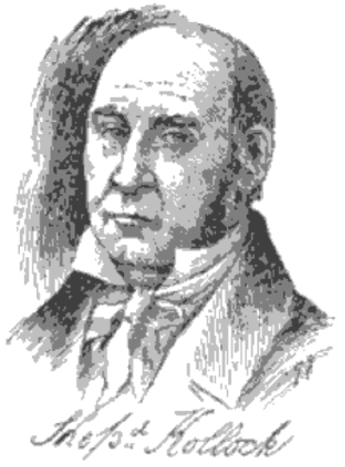
The National Cyclopaedia of American Biography, Vol X, 1900, p. 158
Shepard Kollock, Jr. is a perfect example of how the pen can be mightier than the sword. Though he served as a local soldier for a time, his strongest impact was as an editor and publisher whose works galvanized support for the cause for independence.
He was born in Delaware in September 1750. As a teenager he learned the printing trade from his uncle, William Goddard, editor of the Pennsylvania Chronicle in Philadelphia. Due to health problems, at twenty years old he went to St. Christopher in the West Indies, and there he worked as a journeyman on a newspaper. From the West Indies he helped raise money to send the young boy, Alexander Hamilton, to the colonies to receive a formal education.
When he learned of the Battle of Lexington and the start of the Revolution, he travelled to New Jersey and joined the New York Militia in the summer of 1776 as a 2nd Lieutenant in the Flying Camp. In January 1777 he became 1st Lieutenant in Lamb’s Continental Artillery Regiment in the company of Col. Niell, then Captain by Brevet in the 2nd Regimental Continental Artillery in January 1779. He served during the momentous time in late 1776 that included the evacuation of Fort Lee, the “march across the Jerseys,” the crossing of the Delaware, and the Battles of Trenton and Princeton. He also served in Battles at Long Island, Short Hills, and Monmouth. He helped place the enormous chain across the Hudson at West Point in 1778.
But his real calling was in his words. George Washington wanted someone to publish a patriotic newspaper, and Alexander Hamilton recommended Shepard Kollock. General Henry Knox advised Kollock to his commission in 1779. At the insistence of Continental Congress, Kollock established a printing press in Chatham NJ, where he published his newspaper, the New Jersey Journal. This was the only newspaper published in northern New Jersey during the war. Its first issue was published on 16 Feb 1779, and it soon became a catalyst in the Revolution, reporting events from a pro-American point of view and boosting the morale of the troops, their families, and citizens in the area. The paper publicized information and news that came directly to the editor from Washington’s headquarters nearby in Morristown, and included stirring editorials and lively debates about the struggle for independence. Knowing that British officers would read the paper with great interest, Kollock would publish occasional optimistic accounts of troup conditions at Morristown in order to deceive the British, which might have helped confuse and delay British General Clinton in New York. The angry British called him “the rebel printer” and tried to prevent him from publishing.
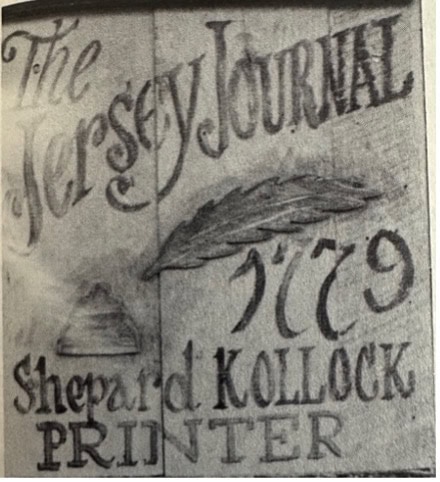
“Shingle” for the New Jersey Journal, from Thayer’s Colonial and Revolutionary Morris County
A print shop such as Kollock’s would have been equipped with an English two-pull press, on which a two-man team could turn out about 200-240 one-sided pages per hour. Other shop equipment would have included inks, mixing stones, brayers, wooden-handled inking balls, and drying racks for the paper. A composing room would have held four wooden trays for italic and Roman type, divided into boxes for each letter or character.
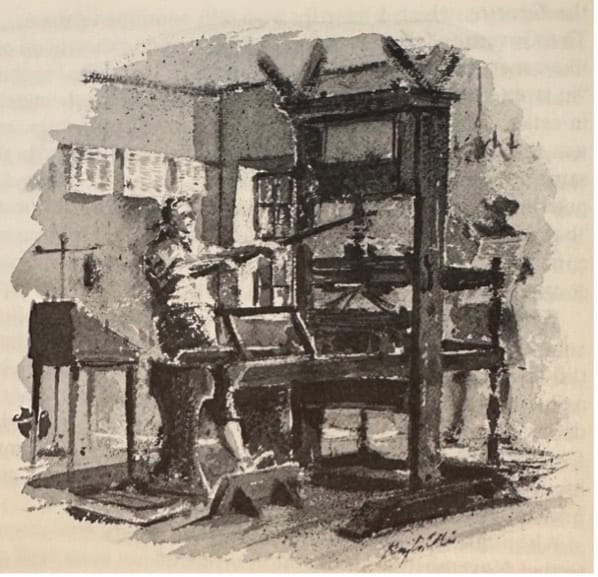
Interior of Shepard Kollock’s Printing Office, From Anderson’s Shepard Kollock: Editor for Freedom
Because paper was in short supply, Kollock needed to construct his own papermill and make his own paper. Most likely, this mill was along the Passaic near Chatham. One of his advertisements for rags needed to make paper read, “The highest price is given for clean linen rags by Sheppard Kollock in Chatham near the Liberty Pole.”
When British troops invaded New Jersey in June 1780 reached Springfield, Kollock evacuated Chatham with his equipment to avoid capture or damage. As a result, the New Jersey Journal missed publication for a week, the only time the newspaper was not published on schedule.
During the war Kollock also published several books including The United States Almanack for the Year of our Lord 1780 (in 1779), The New-England Primer Improved, for the more easy attaining the true Reading of English, To which is added, the Assembly of Divines, and Mr. Cotton’s Cathechism (in 1782), Ebenezer Elmer, Surgeon of the Regiment, An e[u]logy on the late Francis Barber, Esq: Lieutenant Colonel Commandant of the Second New-Jersey Regiment (in 1783). He authored and published Poems on the Capture of General Burgoyne (in 1782).
During the evacuation of New York in 1783, Kollock moved his press to New York and established the New York Gazetteer. Initially published as a weekly paper, its publication was increased to three times a week. In 1784 his printing house was located at the corner of Wall Street and Water Street, and a bookstore that he operated was located on Hanover Square. He published the first New York City directory in 1786, and continued issuing it until 1818. He also started a related paper, the New Jersey Journal and Political Intelligencer at New Brunswick during this time.
He relocated again to Elizabethtown in 1787 and renamed his publication the Elizabeth Daily Journal. With Kollock in charge, the paper advocated for presidents Thomas Jefferson, James Madison, and James Monroe. He sold his printing operation in 1818, and publication continued until its final issue on 3 Jan 1992. At 212 years old, it was the fourth oldest newspaper to be published continuously in the United States, and the oldest newspaper in New Jersey.
Kollock also used his printing press to publish other materials, such as the Journal of the Proceedings and Minutes of Joint Meetings of the New Jersey Legislative Council starting in 1808. He served as judge of the Court of Common Pleas for thirty five years, and led a number of governmental offices in Elizabethtown. He was aide-de-camp for New Jersey Governors Joseph Bloomfield and Aaron Ogden. He was Postmaster of Elizabethtown until 1829. He was also an original member of the Society of the Cincinnati in the State of New Jersey. He received a pension for his military service (Pension W3143).
He was married to Susan Arnett, and together they had twelve children.
Shepard Kollock died in Philadelphia on 28 Jul 1839. He is buried at the First Presbyterian Church of Elizabeth.
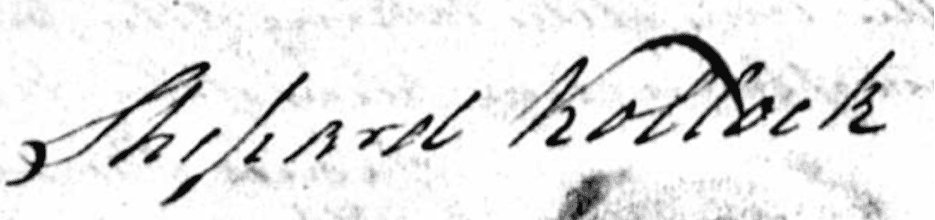
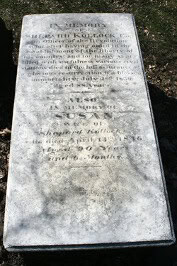
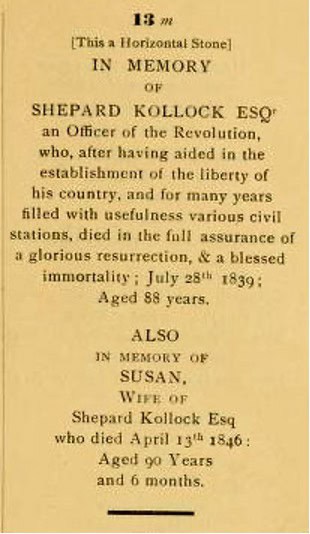
FindaGrave memorial #7237147
His name lives on at Shepard Kollack Park, a recreational field named after him along the Passaic River in Chatham. Some say that the park is located on the site of ovens during and encampment in August 1781, but this cannot be proven. Even so, thousands of Continental Troops walked over and camped on the fields that now make up the park.
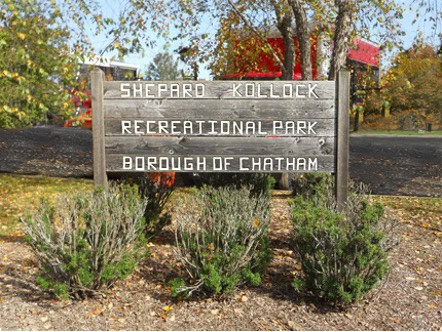

https://www.revolutionarywarnewjersey.com/new_jersey_revolutionary_war_sites/towns/chatham_nj_revolutionary_war_sites.htm
A historic marker located at 55 Main Street in Chatham marks the area where Kollock’s press operated. At first he operated his printing press out of a tavern, and later in a schoolhouse building in Bottle Hill that he bought and moved to Chatham. Both of these buildings were near the site of this sign.
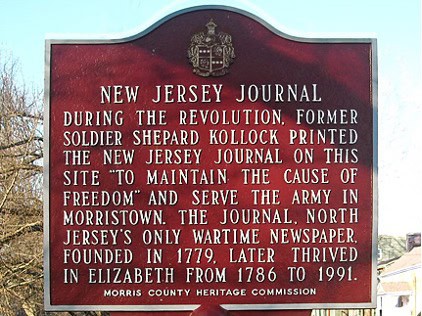
https://www.revolutionarywarnewjersey.com/new_jersey_revolutionary_war_sites/towns/chatham_nj_revolutionary_war_sites.htm
SOURCES
https://en.wikipedia.org/wiki/Shepard_Kollock
https://en.wikipedia.org/wiki/New_Jersey_Journal
https://revolutionarynj.org/people/shepard-kollock/
https://njcincinnati.org/shepard-kollock/
http://famousamericans.net/shepardkollock/
_____, National Cyclopaedia of American Biography, Vol X, New York: James T. White & Co, 1900
Anderson, John R., Shepard Kollock, Editor for Freedom: The Story of The New Jersey Journal in Chatham, 1779-1783, Chatham, NJ: Chatham Historical Society, 1974
National Archives and Records Administration, M804, Pension of Shepard Kollock and widow Susan, W3143
Read, Alice, The Reads and Their Relatives, Cincinnati: Johnson & Hardin Press, 1930
Thayer, Theodore, Colonial and Revolutionary Morris County, Morristown: Compton Press Inc., 1975
Vanderpoel, Ambrose E., History of Chatham, New Jersey, NY: Charles Francis Press, 1921