 In his pension testimony (number S18661), Isaac Wilson (DAR ancestor A127360), told a grueling tale of being taken prisoner for years, but his story has a happy ending in that he survives, raises a family and lives a long life.
Wilson’s story is very different from the stories told by men marching around NJ. Most of the prison stories for Morris County soldiers are about the sugar houses or prison ships in NYC, which by all accounts were terrible and often deadly experiences. But even though Isaac Wilson was a Morris County native, he did not serve around here. He was born in Morris County NJ on 22 Oct 1758. When he was young his family moved to Northumberland Co PA, where he grew up and entered the service as a ranger and scout for the PA troops.
Isaac Wilson testified that he was taken prisoner at Freeland’s Fort, a settlers’ fort in Northumberland Co PA in July 1779. Like most settlers’ forts, it was a house with a stockade fence built around it, erected by citizens to protect themselves during Indian raids, and used sometimes by the frontier militias. A group of Tories, British and Indians led by the famous Indian warrior Joseph Brandt and the notorious Tory Major Butler surrounded and attacked the fort. Brandt and Butler are the same guys that Gen. Sullivan wanted to target on his expedition into New York, along with our dear Dr. Campfield (though we know now that the victims of Sullivan’s expedition were mostly innocent Indian villagers).
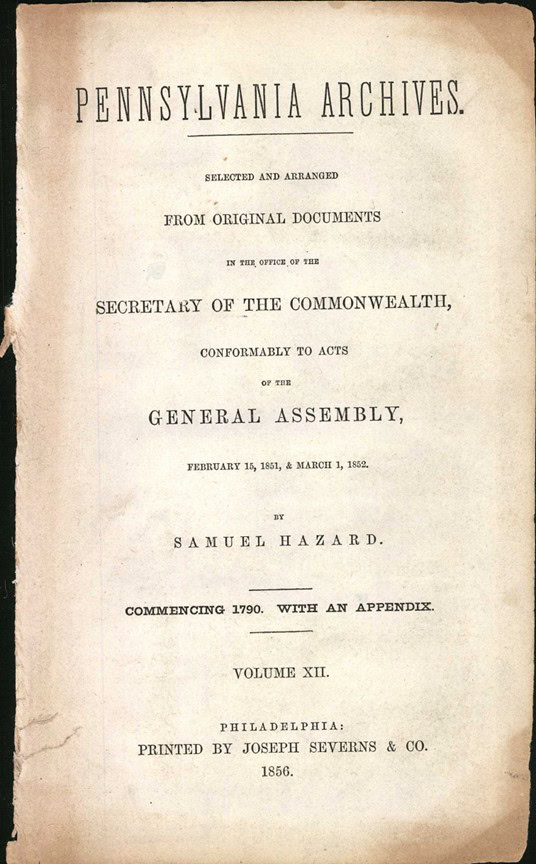
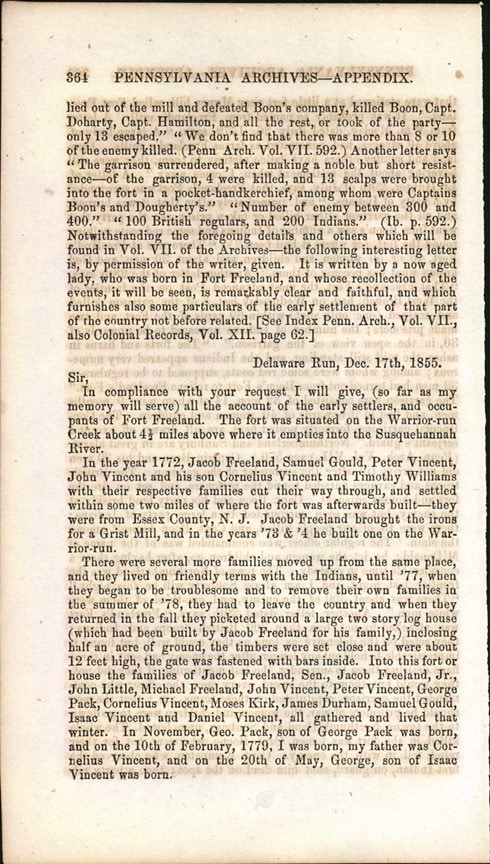
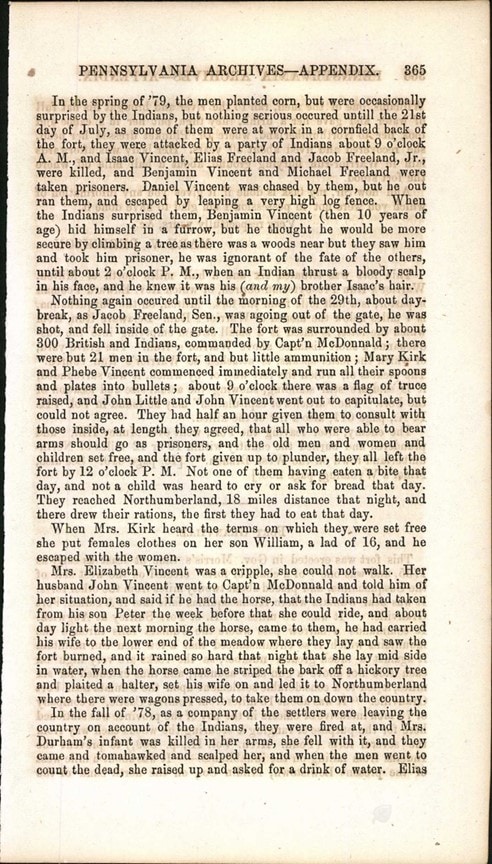
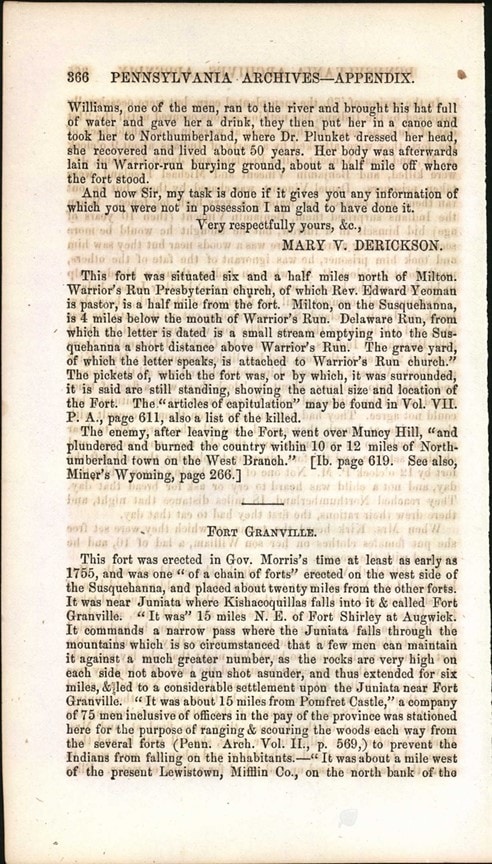
Here’s a description of the attack at Freeland’s Fort, as told by local resident Mary V. Derickson, and documented in the Pennsylvania Published Archives (the full text is attached):
“In the spring of ‘79, the men planted corn but were occasionally surprised with the Indians, but nothing serious occurred until the 21st day of July, as some of them were at work in the corn field back of the fort, they were attacked by a party of Indians,, about nine o clock, A. M. and Isaac Vincent, Elias Freeland and Jacob Freeland, Jr., were killed and Benjamin Vincent and Michael Freeland were taken prisoners. Daniel Vincent was chased by them but he outran them and escaped by leaping a high log fence. When the Indians surprised them, Ben. Vincent (then ten years of age) hid in a furrow, but he thought he would be more secure by climbing a tree, as there was a woods near, but they saw him and took him a prisoner. He was ignorant of the fate of the others until about two o clock P. M., when an Indian thrust a bloody scalp in his face and he knew it was his (and my) brother’s Isaac’s scalp. Nothing again occurred until the morning of the 29th about daybreak, as Jacob Freeland, Sen., was agoing out the gate he was shot and fell inside of the gate. The fort was surrounded by about three hundred British and Indians, commanded by Capt. McDonald. There were but 21 men in the fort and but little ammunition. Mary Kirk and Phoebe Vincent, commenced immediately and run all their spoons and plates into bullets; about nine o’clock there was a flag of truce raised, and John Little and John Vincent went out, to capitulate, but could not agree. They had half an hour given to consult with those inside; at length they agreed that all who were able to bear arms should go as prisoners, and the old men and women and children set free, and the fort given up to plunder. They all left the fort by 12 o’clock P. M. Not one of them having eaten a bite that day and not a child was heard cry or ask for bread that day. They reached Northumberland, eighteen miles distant, that night and there drew their rations, the first they had that day. When Mrs. Kirk heard the terms on which they were set free she put female clothes on her son William, a lad of 16, and he escaped with the women. Mrs. Elizabeth Vincent was a cripple; she could not walk. Her husband John Vincent, went to Capt. McDonald and told him of her situation, and said if he had a horse that the Indians had taken from his son Peter the week before that she could ride about daylight next morning. The horse came to them; he had carried his wife to the lower end of the meadow, where they lay and saw the fort burned, and it rained so hard that night that she laid mid side in the water; when the horse came he stripped the bark off a hickory tree and plaited a halter, set his wife on and led it to Northumberland, where there were wagons pressed to take them on down country.
After the surrender of the fort Capts. Boone and Daugherty arrived, with thirty men; supposing the fort still holding out they made a dash across Warrior run, when they were surrounded. Capt. Hawkins Boone [he was Daniel Boone’s cousin] and Capt. Samuel Daugherty, with nearly half the force were killed; the remainder broke through their enemies and escaped. Thirteen scalps of this party were brought into the fort in a handkerchief. Soon after this the fort was set fire to and burned down. The killed of the garrison and Boone’s party, from best information, to be arrived at amounted to about twenty men, but two such men as Boone and Daugherty in such times were of more value to such a community than many common men.”
Freeland’s Fort is documented by the commission on frontier forts of Pennsylvania, whose report also has a nice picture of the fort (attached below). Here’s a link that takes you to the report which details the fight and also the impact of the loss of this fort on the broader area (just scroll down past a few other forts until you get to Freeland): http://www.usgwarchives.net/pa/1pa/1picts/frontierforts/ff15.html
After a fierce fight at Freeland’s Fort, Isaac Wilson’s unit surrendered, were stripped of their clothes and marched through “Indian country” to Lake Ontario at the mouth of the Genesee River, where they were personally delivered to Maj. Butler. They were tied up and taken by bateaux to Fort Niagara, held prisoner there for 6 weeks, then crossed the Lake Ontario to the St. Lawrence River and taken to Montreal.and held 10 days. He and others came down with “the ague” and were taken to the hospital for several weeks. At some point, he was pressured to join the British cause and refused, so he remained in prison. He was then taken to Fort Chambler on the Sorrell River, handcuffed and imprisoned for the rest of the winter. In spring they were taken to another garrison at the mouth of the Sorrell River and confined and “ironed hand” until Cornwallis’ surrender in autumn 1781. But even then, he was not freed. He was then taken to Quebec for an additional 11 months, then taken to New York in Oct 1782 and finally exchanged. So altogether he was imprisoned for more than 3 years, but he survived the ordeal! He went on to marry Sarah Kniver and raise a large family (Isaac Grier, Samuel, Thomas, James, William, Hyram, John, Matthew, David). He moved west to Clark County Ohio, where he died on 11 May 1841. Here’s a link to the Find-a-Grave entry with a picture of his grave: https://www.findagrave.com/memorial/17973182/isaac-wilson
Fort Freeland, Pennsylvania showing spring and old kitchen
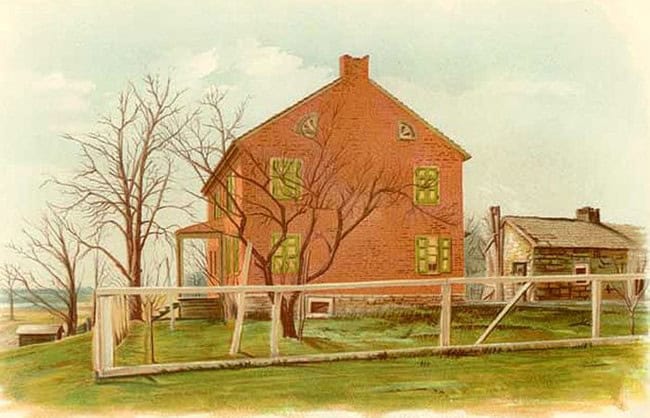 From https://www.legendsofamerica.com/fort-freeland-pennsylvania/