
 An extraordinary personality in Morris County during the Revolution was Reverend Jacob Green, Pastor of the East Hanover Presbyterian Church from 1746 to 1790. Besides managing his church and its congregation, he was an intensely spiritual and zealous writer and political activist who helped sway the public in New Jersey to support the war for independence. His essay advocating the separation of the colonies from Great Britain was published and circulated throughout America. He supported the cause for independence in many other ways, perhaps most notably by chairing the committee who wrote the New Jersey state constitution.
But he is most remarkable for his defense of human rights and impassioned appeals to abolish slavery at a time when public opinion strongly defended it. His prophetic Fast Day Sermon proclaiming slavery “the crying sin of the land” was nationally circulated. His bold and visionary writings on slavery make him exceptional among our nation’s forefathers, many of whom recognized the evil of slavery but did little to end it.
EARLY LIFE
Jacob Green was born in Malden, MA on 22 Jan 1722 to Puritan parents Jacob and Dorothy Llynde Green. His father died when he was an infant, his mother remarried, and the family moved to Killingly, CT. At fourteen he apprenticed for a time with Henry Green (no relation), then left after encountering “some difficulties.” He went to work for his uncle, Daniel Green in Stoneham MA, leaving early due to “pecuniary difficulties,” then went to live with another uncle, Thomas Llynde.
He was heavily influenced by his Puritanical mother, who impressed on him an obsessive fear of eternal damnation at the hands of an angry God and ideas about “the Day of Judgement and future misery.” He told of a dream he had at the age of 14, which manifested his guilt about attempting to commit a sin which he had previously vowed to avoid. Green envisioned a confrontation in which God informed him that he was eternally damned with no possibility of forgiveness for having attempted to commit the sin, even though the attempt failed. This dream haunted him for the rest of his life. He suffered bouts of depression and anxiety throughout his life, what he called periods of “darkness, doubts, and fears” during which he suffered terrible guilt and feelings of spiritual inadequacy.
At sixteen he sold off property that he had inherited from his father to pay for his education, enrolling first at the Stoneham grammar school, then Harvard College. When his money ran short, Harvard granted him three scholarships which allowed him to complete his B.A. degree studying liberal arts such as Greek, Latin, classical literature, mathematics, and oratory.
At Harvard, Green encountered religious ideas that challenged the earlier beliefs learned from his mother, emphasizing salvation through repentance and good works. He was not impressed by these new theologies, considering religion at Harvard to be at a “very low ebb.” Instead, he followed the Great Awakening teachings of itinerant preachers of the evangelical revivalist movement, including George Whitfield of England and Gilbert Tennant of New Jersey. Tennant especially impressed him when he compared the justice and glory of God with the corruption of human nature, and Green wrote that he was “willing to be damned for the glory of God.”
HIS CALLING TO THE MINISTRY
Though Green wanted to pursue graduate studies, his money ran out, so instead he took a teaching job at a grammar school in Sutton, MA. A year later, he accepted an offer from his role model George Whitfield to help for a new orphan house in Georgia. He began traveling south, but when he reached Elizabethtown, NJ, Whitfield told him that the project was cancelled due to financial problems. Soon after, he met Presbyterian ministers Jonathan Dickerson of Elizabethtown and Aaron Burr (father of Vice President Aaron Burr) of Newark, who persuaded him to stay in New Jersey and prepare for the ministry.
Green was apprehensive about his prospective vocation because he doubted his capabilities, felt inadequate, and was inherently shy and fearful of public speaking. At one point he decided to give up the ministry entirely, writing a very negative assessment of himself and giving it to Reverend Burr in hopes that Burr would recommend against ordination. Instead, Burr tossed it into the fire and encouraged Green to continue his pursuit.
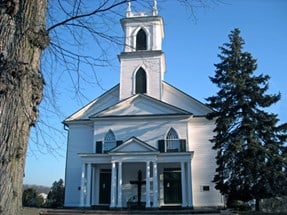
Green spent a year of probationary preaching at the Hanover Presbyterian Church in Morris County, then was ordained in November 1746 at the age of 24. He remained a pastor at Hanover for the rest of his life.
Hanover Presbyterian Church, from https://www.revolutionarywarnewjersey.com/new_jersey_revolutionary_war_sites/towns/east_hanover_nj_revolutionary_war_sites.htm
 For the first twelve years of his ministry, Green opposed ministers’ involvement in worldly affairs and relied completely upon his congregation’s stipend, which he found insufficient to support his growing family. On the advice of members of his congregation that country ministers like him should support their own families, he eventually built several successful businesses including a sawmill, grist mill, and applejack distillery. He was also a land speculator and farmer, acquiring 150 acres of farmland which was worked mostly by tenants and hired hands, as well as enslaved person, in stark contrast to his later public stance against slavery. He also practiced medicine and law, which did not require specialized training or certification at the time. While these secular ventures were financially successful, he would say of them that “when he entered upon worldly schemes, he found them in general a plaque, a vexation and a snare. If he somewhat increased his worldly estate, he also increased sorrow and incurred blame in all things except the practice of Physick [i.e., medicine]”
Despite his success in ministry and in business, Green remained intensely self-critical. At the age of 55 he wrote, “I have been a poor, unprofitable creature in the ministry, and have many a time thought that I was never really fit for the work.” But Green’s followers felt otherwise. His son Ashbel wrote that Green’s audiences “were occasionally melted into tears, by the simple pathos of his address.” According to a neighboring pastor, Green’s congregation experienced, under his spiritual leadership, a “special outpouring of the Holy Spirit…like rain on the mown grass; as showers that water the earth.”
He was a founding trustee of the College of New Jersey (now Princeton University) in 1748 where he continued until 1764, and he served as acting president for 8 months in between the tenures of Presidents Jonathan Edwards and Samuel Davies. He also directed its grammar school.
Green also read extensively, accumulating one of the largest libraries in the colonies. He had a great interest in classical languages and became known as the foremost authority on Hebrew in America. He founded a Latin school, where he taught along with eight others including his son Ashbel. Among his students at this school was Mahlon Dickerson, who went on to become a New Jersey Governor and Senator. The College of New Jersey bestowed on him an honorary masters’ degree in 1749.
Green favored a New England-style church government where independent congregations were ruled locally, as opposed to ecclesiastical bodies associated with the Presbyterian Church. This put him in conflict with the New York Presbytery, from which he seceded in 1780 to establish an independent Morris County Presbytery.
REVOLUTIONARY WAR
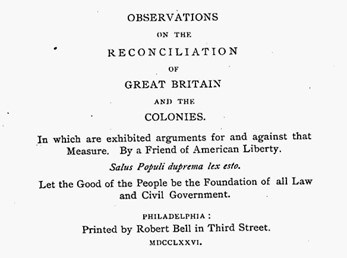
Green’s aversion to centralized church government extended to his opposition to centralized political rule by British authorities. His Observations on the Reconciliation of Great Britain and the Colonies was published in April 1776 and very widely circulated, becoming the only pro-independence pamphlet to be written by a New Jersey citizen. In contrast to other revolutionary pamphlets of the time, which were filled with angry fanatical writing, his writing was clear and well-reasoned. He discussed theories of the origin of civil government and asserted that “the whole design of civil government is the good of the people. A magistrate has no right or authority but from the people and for the people.” He described emphatically the oppressive measures and Britain towards Americans, and recommended vehemently against any plan for reconciliation short of independence. In his final note, he added, “I wish that I could add that the guilt of slavery would be banished from us, and I cannot but hope that in time it may. What a dreadful absurdity! What a shocking consideration that people who are so strenuously contending for liberty should at the same time encourage and promote slavery!”
Cover of Jacob Green’s Observations pamphlet, from Tuttle’s Rev. Jacob Green of Hanover, NJ
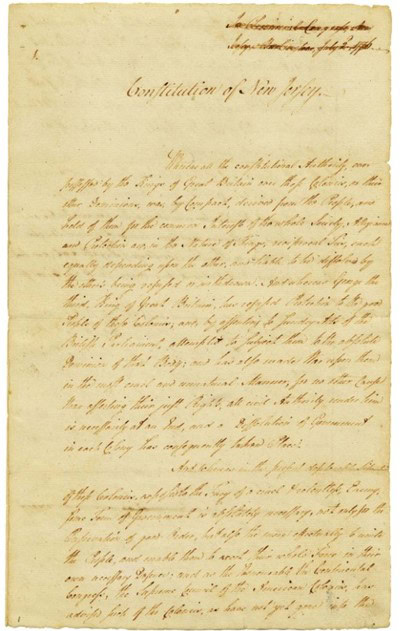
 In June 1776, Green served as delegate from Morris County to New Jersey’s Provincial Congress. Here he voted for the arrest of New Jersey Governor William Franklin and the installation of a new revolutionary government. He also chaired the 10-member committee which wrote New Jersey’s first state constitution, which was adopted in July 1776. This document was composed in only five days, and although originally it was intended to be a temporary charter, it remained in effect for 68 years.
First page of New Jersey’s first constitution, from https://www.nj.gov/state/archives/docconst76.html
 When the Continental Army arrived in Morristown during the winter of 1777 and a smallpox outbreak took its toll, Jacob Green administered to the needs of soldiers and civilians. He converted his church into a military hospital and helped inoculate the army. George Washington consulted Green and others before ordering the inoculation program, and Green helped convince him that the army “could be carried through the small-pox with very little danger,” and that not to inoculate most likely would result in “the disaster of the natural small-pox in its worst form, spreading through the whole population.”
Also during the winter of 1777, Green sheltered ten officers from Virginia and several enlisted men in his small house, along with his family of nine. The officers’ foul language shocked him, and he was dismayed that they wanted to do nothing but play cards. The soldiers continued playing cards while one soldier died of fever in the house, only stopping when their commanding officer finally threatened them to remove the corpse.
Green opened his home again during the winter of 1778, this time to shelter sick and impoverished people who were released from British prisons. His son Ashbel described their terrible condition, “Twelve of these pitiable objects were brought in a wagon and laid down at my father’s door, most of them so helpless that they could not get into the house without assistance. They were all taken in, and the whole family immediately employed in cleansing and clothing them, preparing for them suitable food, and in every way ministering to their necessities. Ten of the twelve were shortly after removed into neighboring families…I cannot pretend to say how many of those who were brought in carriages and left in my father’s parish never recovered. I can only say that a number of them died.”
Fast Day Sermon
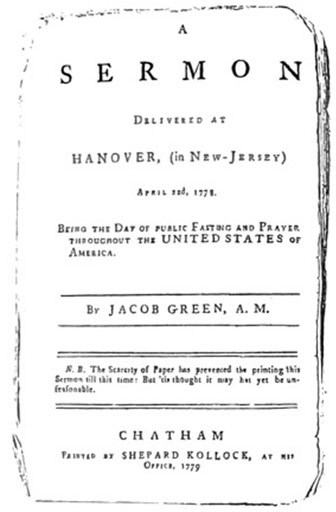
At a time when prospects were gloomy, Continental Congress declared 22 Apr 1778 a day of fasting and prayer. Pro-revolutionary clergymen throughout the colonies responded by delivering fast day sermons, and Jacob Green answered the call with a sermon in which he supported the war against Great Britain while also calling for social reform at home. This sermon was published as a pamphlet by Shepard Kollock of Chatham and widely circulated nationwide. He prefaced his Fast Day Sermon by saying that he intended to please God, but that he would “not be disappointed” if his words offended the public. He contended that God permitted British oppression of the colonists to motivate them to defend their civil and religious liberty. He viewed the war as a glorious cause for which he asked God’s blessing.
But he tempered his remarks with concern that God might withhold his blessing and let the British prevail as a way of punishing Americans for their sins. He called upon the people to repent for their sins, including “negligence in defense of our civil and sacred rights.” This included the practice of slavery, which he called “one of the great and crying evils among us.” He condemned the hypocrisy of those who tolerated slavery while professing freedom by asking, “What foreign nation can believe that we who so loudly complain of Britain’s attempts to oppress and enslave us, are at the same time, voluntarily holding multitudes of fellow creatures in abject slavery…while…declaring that we esteem liberty the greatest of all earthly blessings?” He cited examples from the book of Amos in the Old Testament in which God punished entire cities for acts of injustice against humanity. He cited passages in the New Testament that rank “man-stealing” (i.e., the slave trade) with patricide, matricide, “whore-mongering” and perjury. He urged slave masters to free their slaves and pressed “friends of liberty” to petition their legislatures to end slavery, claiming that the very survival of the country as a free nation depended on it. Noting that the common acceptance of slavery in the American colonies made people oblivious to its evil, Green pointed out that while this ignorance might extenuate the sin of owning slaves, it did not free the slaveowner from guilt.
Green hoped that the war for independence would trigger an end to slavery and create “a land of liberty, of peace, and plenty” where everyone would live together in the spirit of brotherly love. But presciently, he warned that the new nation could not sustain peace and harmony if slavery continued. He prophesied that “[W]e shall have inward convulsions, contentions, oppressions, and even calamities, so that our liberty will be uncomfortable, till we wash our hands from the guilt of negro slavery.”
Almost 100 years later, Green’s Fast Day Sermon remained a source of inspiration to those supporting the Union cause during the Civil War. When Lincoln proclaimed a day of prayer and fasting on 26 Sep 1861, Green’s sermon was republished and widely praised.
Cover of Jacob Green’s Fast Day Sermon, from Mitros’ book, Jacob Green and the Slavery Debate
THE SLAVERY DEBATE
Green convinced his congregation to adopt articles of agreement which prohibited church members from owning slaves. By this action, Green’s congregation became the only Presbyterian church in America during the Revolutionary era to make slaveholding a basis for exclusion from church membership. But despite his congregation’s action, pro-slavery sentiment predominated in Morris County and northern New Jersey, and Green’s opponents defended their right to keep their “property.”
Writing under the pseudonym of Eumenes (a famous general under Alexander the Great), Green wrote a two-part letter entitled On Liberty in Shepard Kollock’s New Jersey Journal on 3 and 10 May 1780. In it he questioned, “We are now engaged in a cruel war…Is it not proper to consider what all this is for?” Echoing the Declaration of Independence, he answered the question with a vehement defense of the war against Britain as a struggle for liberty as “one of the unalterable rights of human nature.” He argued that there would be no wars if freedom-loving men refrained from depriving others of freedom. He introduced the subject of slavery in the final sentence, suggesting that people should express their gratitude for God for the gift of freedom by casting “an eye of pity on the negro slaves among us, who are groaning under a bondage, which we think worse than death.”
Green’s letters triggered a debate that continued for several months in issues of the New Jersey Journal.
In response to Green’s On Liberty, a writer under the pseudonym Eliobo wrote a two-part letter explaining his reasons for opposing the freeing of slaves. Eliobo claimed he did not own slaves and opposed further importation, not due to any moral reason, but rather because their costs outweighed their benefits. Even so, Eliobo opposed liberation of existing slaves, fearing that the freed slaves would build “a kingdom and empire of their own” by joining forces with Native Americans, destabilizing society. Eliobo explained that these “savage enemies…who alone are always sufficient to keep us in terror and dread, now being joined by 200,000 Negroes…will sweep our land [with] sallies of murder and rapine. Then will the shrieks and cries of murdered children, and the lamentation of assassinated friends weltering in gore, force conviction upon us of the evils we might have foreseen.” Fearful of the prospect of interracial marriage, Eliobo feared that the nation would eventually “swarm with mulattos” whom white people “would be obliged to acknowledge…[as] kindred relation.” He dismissed moral arguments for emancipation by saying that blacks experienced contentment and happiness attributed to their slave upbringing. According to him, the idea of bondage “is inculcated upon them in their youth.” In this “state of dependence,” where they remain “ignorant of the nature of freedom,” he asserted that their happiness exceeds that of their masters.
Responding to Eliobo and writing as Eumenes, Green ridiculed Eliobo’s race war scenario. Substituting the word “slaveowner” for “Negro” in Eliobo’s argument, Green satirically suggested that slaveowners, not slaves, presented the real threat to society because of the likelihood that they would join the British and oppose their fellow Americans.
The satirical nature of Jacob Green’s letter was unclear to some readers, including a man who called himself Marcus Aurelius (after the Roman emperor and stoic philosopher). Not recognizing that Green’s letter was a parody that mocked Eliobo’s belief that freed slaves would join Native Americans in an anti-white rebellion, Marcus Aurelius wrote two letters to the New Jersey Journal which viciously attacked Green’s character as self-righteous and arrogant, someone who “look[ed] down upon all the rest of mankind with the most superlative contempt” and sowed seeds of “disunion and discord, jealousy and ill will.” He rejected Green’s contention that slaveowners would join the British, and instead suggested that slaveowners value freedom more than anyone because they see first-hand what it means to be enslaved. Like Eliobos, Marcus Aurelius said that the enslaved cannot conceive “of a greater degree of happiness here…than that of a kind and indulgent master,” and that “It is natural to them, like a child, to look up with gratitude and reverence to the hand that feeds and clothes them.”
Green responded with two more letters, his last in the series, reassuring readers that he did not equate slaveowners with Tories. He declared his commitment to the ideals of the Revolution and expressed a desire for its “speedy and proper end.” But he added that we could not truly attain peace as long as God looked unfavorably upon America for tolerating slavery, which he called “one of the greatest evils…so inconsistent with the principles on which the present war is founded.”
*****
Jacob Green married Anna Strong in 1747, and they had four children before she died in 1756 of tuberculosis. He married Elizabeth Pierson in 1757, with whom he had another seven children, most notably son Ashbel, who served as Chaplain of the United States House of Representatives from 1792 to 1800 and President of Princeton University from 1812 to 1822.
Jacob Green died of influenza on 24 May 1790 at the age of 68. He is buried in the burying yard of the East Hanover Presbyterian Church. His tablet tombstone is inscribed with an epitaph written by his son Ashbel,
Under this stone are deposited the remains of the Rev. Jacob Green, A.M., first pastor of the Hanover church, who died 24th May, A.D. 1790, age 68 years, of which, 44 were spent in the gospel ministry. He was a man of temper even, firm and resolute; Of affections temperate, steady, and benevolent; Of genius solid, inquisitive and penetrating; Of industry active and unwearied; Of learning, various and accurate; Of manners, simple and reserved; Of piety, humble, enlightened, fervent and eminent. As a preacher, he was instructive, plain, searching, practical; As a pastor watchful, laborious; Ever intent on some plan for the glory of God, and the salvation of his flock; And, by the divine blessing, happily and eminently successful.
Jacob Green’s tablet tombstone, Find-a-Grave Memorial #8336379
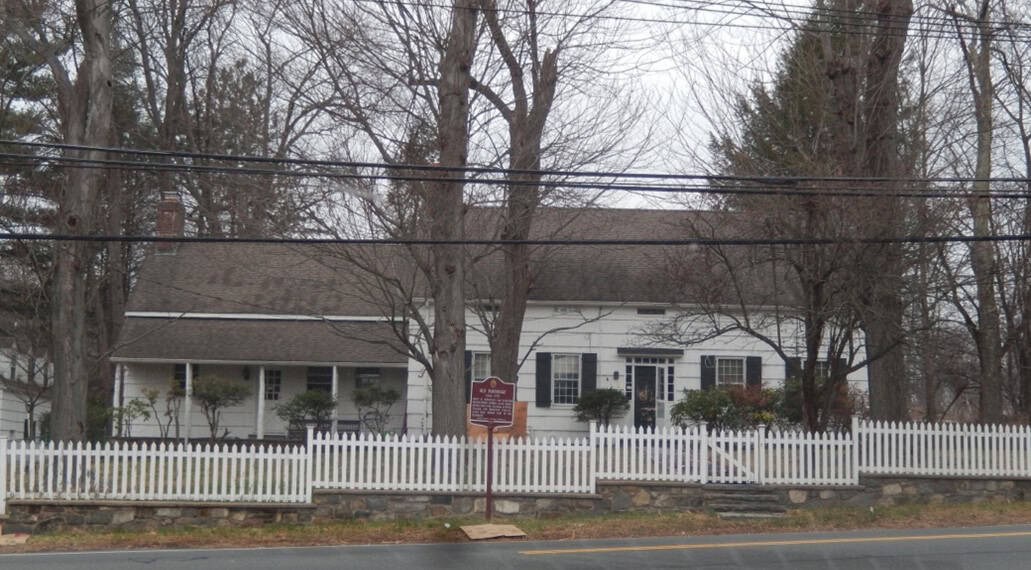
 The “Old Parsonage,” where Jacob Green lived from 1757 until he died, is now a private residence at 27 Hanover Road, East Hanover, NJ. A historic marker in front honors Reverend Green as a political activist, teacher, and Princeton trustee.
The Old Parsonage, photographed by Don Morfe, https://www.hmdb.org/m.asp?m=91677
SOURCES
Green, Jacob, A Sermon Delivered at Hanover, (in New-Jersey) April 22nd, 1778. Being the day of public fasting and prayer throughout the United States of America, transcribed online by the University of Michigan’s Evans Early American Imprint Collection, here:
Green, Jacob, Observations on the Reconciliation of Great-Britain, and the Colonies, online here: https://static1.squarespace.com/static/590be125ff7c502a07752a5b/t/5ce56885f7b58f0001261990/1558538376288/Green%2C+Jacob%2C+Observations+on+the+Reconciliation+of+Great-Britain%2C+and+the+Colonies.pdf
Mitros, David, Jacob Green and the Slavery Debate in Revolutionary Morris County New Jersey, The Morris County Heritage Commission, 1993.
Tuttle, Joseph F., Rev. Jacob Green of Hanover, NJ, available online at ancestry.com
_____, New Jersey State Constitutions, https://www.nj.gov/state/archives/docconstitution.html
https://en.wikipedia.org/wiki/Jacob_Green_(pastor)
https://en.wikipedia.org/wiki/Ashbel_Green
Morristown ChapterDaughters of the American Revolution