
Soldiers’ Story: A Tale of Two Hessians

Most Hessian soldiers fought on the side of the British during the Revolution, but there were exceptions. Here are two stories of Hessian soldiers who demonstrated their commitment to the United States and became local citizens right here in Morris County.
Private Peter Kise
Peter Kise (DAR ancestor A065716) was born in the German states. DAR records indicate he was born ca. 1752, though his pension testimonies report birth dates of 1754 and 1760. A baptism record on ancestry.com suggests that 1760 might be the correct date.
Kise traveled across the Atlantic with the Hessian troops to New York, but when he arrived on what he called “York Island” he deserted and found his way to West Point. There he enlisted in the Continental Army in Colonel Lamb’s 2nd Regiment Artillery of the New York Line and served a three-year term. Stryker also lists him as serving in the militia or state troops in New Jersey, perhaps after completing his Continental Army service.
Kise remained in New Jersey, marrying Mary Morgan. Barbara Hoskins reported that he lived in Mendham, while the 1914 History of Morris County states he lived in Warren County. He applied for a pension in 1818 while living in Pompton Township, and when he reapplied in 1820 he was residing in Bergen County (pension S33355).
He led a simple life with few assets. In 1820, his entire inventory included a milk cow, an iron pot, a tea kettle, two pails, one churn, a table and four chairs, a dresser, three cups and saucers, six plates, and an old teapot.
He is proven by DAR to have had a son Henry, and in his 1820 pension statement he claimed to have a ten-year-old daughter, Peggy—surprising since he also claimed he was 58 and his wife was 77 at the time.
DAR records say he died in Pompton, Morris County post-1818, though other evidence shows he lived longer. His pension payments continue at least to 1832. Hoskins reported that he died in Newark. His burial site is unknown.
Leopold Zindle
Leopold Zindle was born in 1758 in Essinger, Daun, Rheinland-Pfalz, German States. He came to America as part of the Hessian auxiliary to the British Army, serving in the Erbprinz Regiment from Hessen-Kassel, a fusilier regiment using light flintlock muskets and wearing dark blue uniforms with rose facings.
Zindle was captured at Paulus Hook (modern Jersey City) on 20 August 1779 and taken prisoner by the Americans. Along with 250 other Hessian POWs, he was sent to work at the Mount Hope iron works under John Jacob Faesch, chopping wood in the “coaling job.”
At war’s end the British attempted to recover all POWs, since they had to pay financially for any who were not returned. When a British officer ordered Zindle to go with him, Zindle refused, stating he would rather die than return. The officer struck him with a sword, reportedly breaking it into three pieces—one piece embedded in Zindle’s body, one in the officer’s hand, and one falling to the ground. Despite the attack, Zindle still refused.
Because Zindle had many friends among the bystanders, who were ready to defend him, the officer withdrew to avoid being killed.
Zindle lived the rest of his life in the Mt. Hope/Rockaway area. He married Anna Margaretha Schaak and raised a large family: Abraham, George, Charles, Mary, Margaret, Catherine, Sarah, and Leopold. A “Lapold Sindle” is reported to have served in the Pequannock Township militia in 1793, though confirmation is lacking. He died in Rockaway in 1821 and is buried at the Rockaway Presbyterian Church cemetery.
Background About the Hessians
The Hessians were soldiers from Germanic states serving as auxiliaries to the British Army during the Revolution. About 30,000 German soldiers served, with roughly 65% from Hesse-Kassel and others from Hesse-Hanau, Brunswick, Ansbach-Bayreuth, Anhalt-Zerbst, and Waldeck.
The Hessians are often mistakenly called mercenaries, but there is a key distinction: mercenaries hire out individually, whereas auxiliaries fight as organized units under their own officers, uniforms, and flags. Many small German states relied on auxiliary agreements as a major source of income.
Hessian soldiers were considered excellent fighters, trained under strict discipline and harsh punishment. Morale was high, pay was good, officers were well educated, and promotions were merit-based. They typically wore blue or green coats. Grenadiers wore tall gold miter caps that made them appear even taller.
Hessians were instrumental in British victories in 1776 (Long Island, White Plains, Fort Washington) but suffered major losses at Trenton (1776) and at Bennington (1777). In June 1780, Hessian forces under von Knyphausen were prevented from reaching Morristown after being stalled by New Jersey militia and the Continental Army at Connecticut Farms and Springfield.
Many Hessian POWs were held in central Pennsylvania, where large German communities helped ensure good treatment. At the war’s end, about 5,000 Hessians stayed in America for its freedoms and land opportunities; about 17,000 returned to Germany; and about 7,700 died, mostly from illness or accidents.
The Headless Hessian of the Great Swamp
No local story of Hessians is complete without the legend of the Headless Hessian who haunts the Great Swamp. With no claims of historical accuracy, here is a short video sharing the tale and its supposed connection to Washington Irving’s Legend of Sleepy Hollow:
https://www.youtube.com/watch?v=xd04dsqQ7TQ
Regiment von Ditfurth
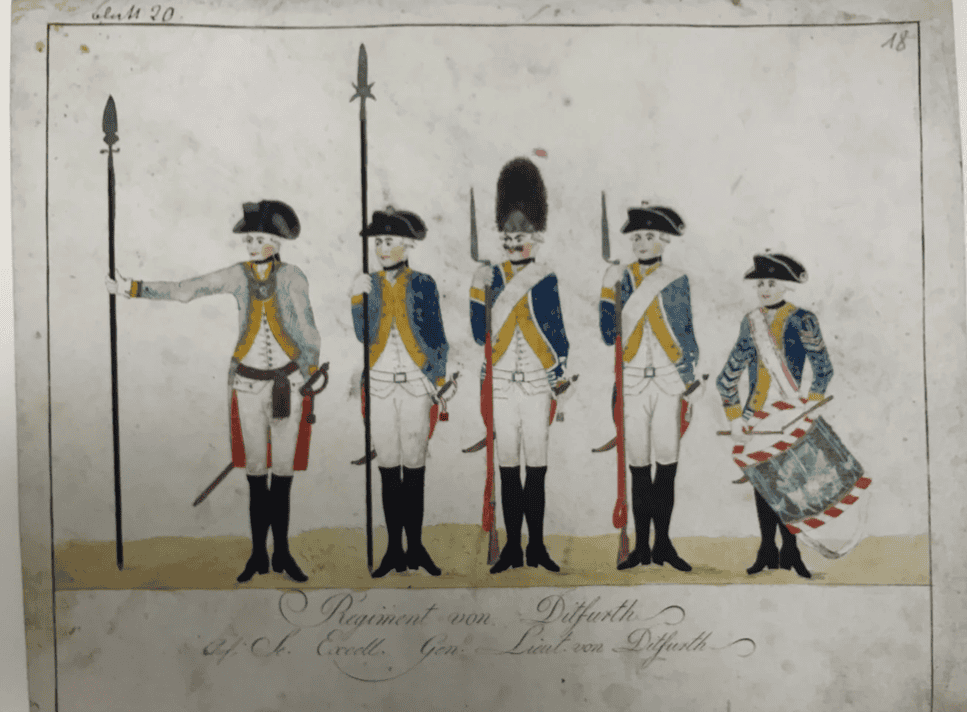
Regiment von Ditfurth, “bedeckte sich durch die standhafte Verteidigung von Charleston mit Rufe” (“earned honor with the steadfast defense of Charleston”), Hessen-Kassel Truppenbestand 1785 Uniformtafeln, 2° Ms. Hass. 267, Blatt 20, Kassel University Library, Murhard’sche.
Sources
- Collins, Bethany. “8 Fast Facts About Hessians,” Journal of the American Revolution, 2014.
- Pension of Peter Kise, S33355, National Archives (RG15).
- History of Morris County, New Jersey, W. W. Munsell & Co., 1882.
- A History of Morris County, New Jersey: 1710–1913, Lewis Publishing Co., 1914.
- “Hessian (soldier),” Wikipedia.