

SOLDIERS’ STORY: PRIVATE JAMES COLEMAN’S CRIME AND PUNISHMENT
During the winter of 1779-1780 in Morristown, a total of 147 men were tried for desertion. The punishment depended on the severity of the offense and the level of remorse demonstrated. A common punishment was lashing, typically 100 lashes, though a up to 1000 could be assigned for more serious offenses. Some of those convicted were assigned to serve on military ships, from which escape is more difficult. More severe punishment could include death by hanging or firing squad. Even those sentenced to death might receive a last minute reprieve by General Washington.
This brings us to the noteworthy story of the crime, trial, and punishment of Private James Coleman of the 11th Pennsylvania Regiment.
Coleman’s Court Martial was held in a hut in the Connecticut Line at Jockey Hollow in April 1780. His trial was a General Court Martial, reserved to handle the most serious crimes. Colonel Israel Shreve presided over a court of thirteen officers. The General Court Martial had the authority to inflict capital punishment, though a death sentence required the assent of two-thirds of the board members. All verdicts of a General Court Martial would be reviewed by the Commander-in-Chief (General Washington), the general commanding a department, or Congress, who could order a pardon or reduction of the sentence but could not increase the court’s sentence.
Private Coleman was found guilty not just of deserting himself, but also “guilty of forging a number of discharges, by which he and more than a hundred soldiers had left the army.” The broad impact of his crime was not taken lightly.
General Washington’s General Orders on 1 May 1780 indicated, “James Coleman a Soldier in the 11th Pennsylvania regiment was tried on the 29th ulto at the General Court martial whereof Colonel Shreve is president for “Repeated Desertion Forgery and disposing of his Arms and Accoutrements.” Pled Guilty. The Court are of opinion that he is Guilty of a breach of the 1st Article 6th Section and 3d Article 12th Section , of the Articles of War and do sentence him to suffer Death more than two thirds of the Court agreeing. The Commander in Chief confirms the Sentence.”
On 25 May 1780, Washington issued orders to execute Coleman and ten others, almost all deserters. His orders read, “The Criminals now under Sentence of death are to be executed tomorrow morning Eleven o clock near the Grand parade: Fifty men, properly officered from each brigade to attend – The Camp colour men from the Pennsylvania-Connecticutt and York Lines under the direction of a Serjeant from each to dig the Graves this afternoon.”
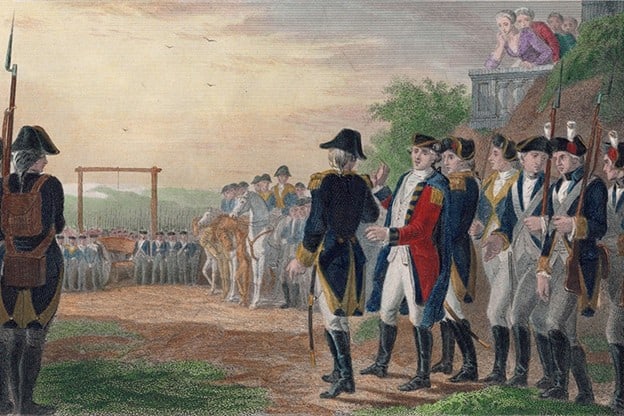
26 May 1780 was a cold and rainy day, fitting of such a somber event. General Washington reported in his diary, “Raining moderately all the forenoon with a little thunder – thick and misty afterwards – wind Northerly.” New York City printer Hugh Gaine wrote more explicitly in his journal, “Uncommonly cold for the Season and some Rain…Still disagreeable weather for the season as ever was known.”
Dr. James Thacher described the unfolding of events of that day in his journal, “Eleven soldiers are condemned to suffer death for various crimes, three of whom are sentenced to be shot; the whole number were prepared for execution this day, but pardons were granted by the commander-in-chief to those who were to have been shot, and the seven others while under the gallows. This was a most solemn and affecting scene, capable of torturing the feelings even of the most callous breast. The wretched criminals were brought in carts to the place of execution. Mr. [William] Rogers, the chaplain, attending them to the gallows, addressed them in a very pathetic manner, impressing on their minds the heinousness of their crimes, the justice of their sentence, and the high importance of a preparation for death. The criminals were placed side by side, on a scaffold, with halters around their necks, their coffins before their eyes, their graves open to their view, and thousands of spectators bemoaning their awful doom. The moment approaches when every eye is fixed in expectation of beholding the agonies of death – the eyes of the victims are already closed from the light of this world. At this awful moment, while their fervent prayers are ascending to Heaven, an officer comes forward and reads a reprieve for seven of them, by the commander-in-chief. The trembling criminals are now divested of the habiliments of death, and their bleeding hearts leap for joy. How exquisitely rapturous must be the transition when snatched from the agonizing horrors of a cruel death and mercifully restored to the enjoyment of a life that had been forfeited! No pen can describe the emotions which must have agitated their souls. They were scarcely able to remove from the scaffold without assistance. The chaplain reminded them of the gratitude they owed the commander-in-chief for his clemency towards them, and that the only return in their power to make, was a life devoted to the faithful discharge of their duty.”
But Private James Coleman was considered more culpable and was not pardoned. His execution did not go smoothly. An account printed in The Pennsylvania Evening Post in Philadelphia on 6 June 1780 under the heading “CHATHAM, May 31” described Coleman’s execution “near the grand parade” in Jockey Hollow, NJ., on 26 May. “The whole being conducted with much solemnity, we cannot but give the following particulars to the public” – Upon the arrival of the criminals at the place of execution, the attending chaplain, rev. mr. Rogers, of gen. Hand’s brigade, prayed and recommended them severally to God, particularly Coleman, who was first to suffer. Prayer being over, the unfortunate wretch was fixed to the gallows, and, previous to his exchanging worlds, addressed the officers and soldiers of the army with the greatest composure. The soldiers he earnestly warned against desertion and forgery. The officers he intreated not to use their soldiers with too much severity and never to promise them more than they were able to perform. Putting up a few short ejaculations, he made a signal to be turned off. A disagreeable accident now happened in the rope’s breaking. Recovering, he mounted the ladder again, repeated his exhortation to the soldiery, and was a second time turned off. The fortitude with which he died, his resolution and modest deportment, during the whole scene, justly astonished the surrounding spectators, and caused them sincerely to wish that by a better life he had procured a better end.”
And so ended the life of this soldier who suffered the ultimate punishment for his misguided deeds.
SOURCES
General Orders, 20 April 1780, https://founders.archives.gov/documents/Washington/03-25-02-0311
General Orders, 1 May 1780, https://founders.archives.gov/documents/Washington/03-25-02-0371
General Orders, 25 May 1780, https://founders.archives.gov/documents/Washington/03-26-02-0108
Proclamation of Pardon, 26 May 1780, https://founders.archives.gov/documents/Washington/03-26-02-0124
Boyle, Joseph Lee, Revolutionary War Desertions, excerpt from his book “He Loves a Good Deal of Rum”: Military Desertions during the American Revolution, https://myemail.constantcontact.com/-REVOLUTIONARY-WAR-DESERTIONS—by-Joseph-Lee-Boyle.html?soid=1011087220548&aid=mFopOpMHpQI
Olsen, Eric, Courts & Crimes, manuscript part 3 of the series Law and Order: Continental Army, Morristown National Historical Park
Thacher, James, Military Journal of the American Revolution, From the commencement to the disbanding of the American Army; Comprising a detailed account of the principal events and Battles of the Revolution, with their exact dates, And a Biographical Sketch of the most Prominent Generals, Hartford: Hurlbut, Williams & Company, 1862